









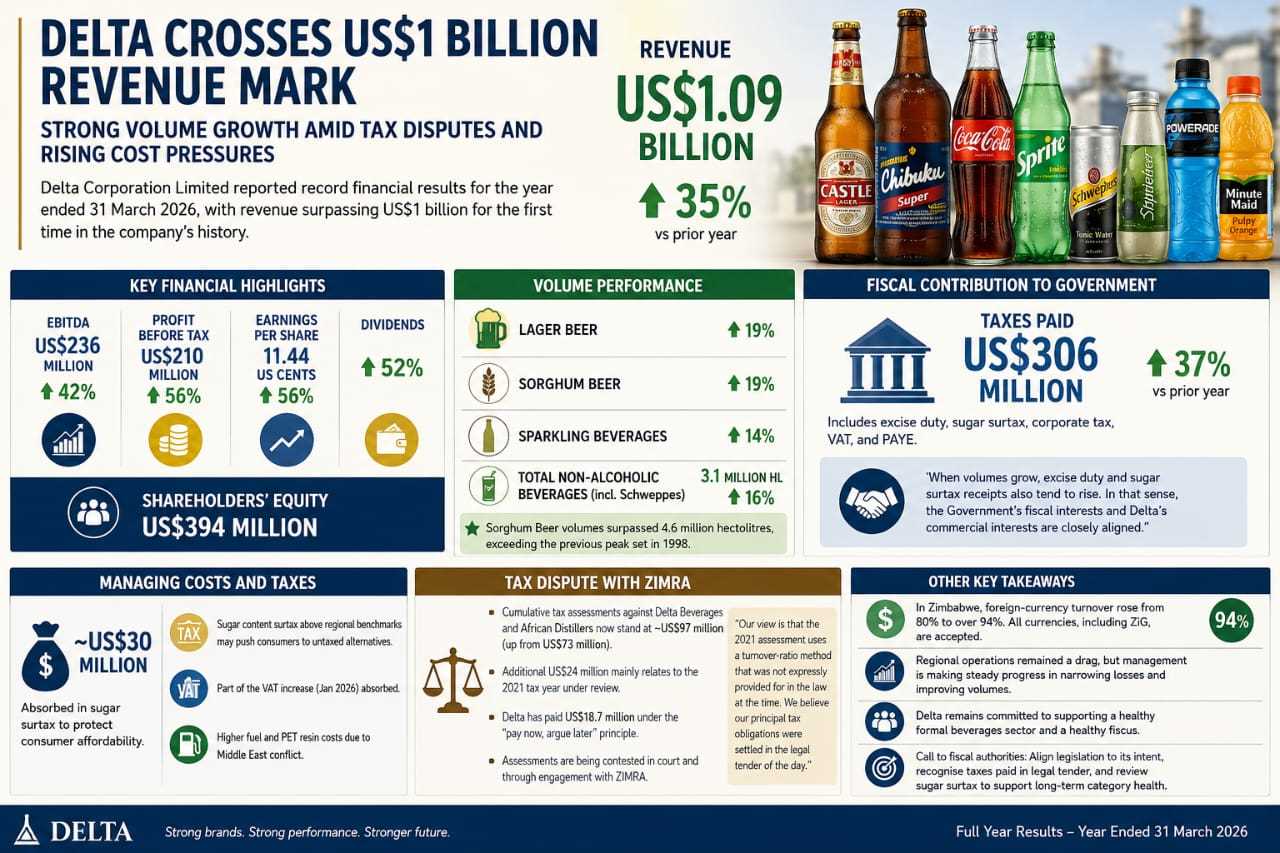
Delta Corporation crossed the US$1 billion revenue mark for the first time in its history in the financial year ending March 2026, as strong volume growth across beer, soft drinks and spirits helped offset mounting tax pressures, rising input costs and lingering disputes with the Zimbabwe Revenue Authority.
The beverages giant reported revenue of US$1.09 billion, up 35% year-on-year, while earnings before interest, tax, depreciation and amortisation (EBITDA) rose 42% to US$236 million. Profit before tax increased 56% to US$210 million, while earnings per share climbed 35% to 11.44 US cents.
The results underscore both the resilience of Zimbabwe’s formal consumer sector and the growing dominance of US dollar trading within the economy, with Delta saying foreign currency sales now account for more than 94% of local turnover.
“Revenue crossed the US$1 billion mark for the first time in Delta’s history, reaching US$1.09 billion, up 35%. The broader story is volume growth. Consumers are choosing our brands in greater numbers across every category,” the company said in a media briefing accompanying the results.
The company’s lager beer and sorghum beer operations both recorded 19% volume growth, while sparkling beverages volumes increased 14%. Total non-alcoholic beverage volumes, including the recently consolidated Schweppes Holdings Africa Limited, reached 3.1 million hectolitres, up 16%.
Delta said sorghum beer volumes surpassed 4.6 million hectolitres, exceeding the previous peak recorded in 1998, highlighting sustained demand despite rising competition from informal alcohol alternatives.
“Sorghum Beer Zimbabwe surpassed 4.6 million hectolitres, exceeding the previous peak set in 1998. In a competitive category, and with informal alternatives in the market, that speaks to brand equity built over decades,” the company said.
However, the strong financial performance was accompanied by growing concerns over Zimbabwe’s tax environment and broader operating costs.
Related Stories
Delta disclosed that it absorbed nearly US$30 million in sugar surtax costs rather than fully passing the burden onto consumers, warning that high taxes could drive consumers toward informal and untaxed products.
“The sugar content surtax remains above regional benchmarks. In our view, that may push some consumers toward unregulated, untaxed alternatives, which would not be positive for the fiscal base or for local producers,” the company said.
The company also said it absorbed part of the VAT increase introduced in January 2026, alongside higher fuel and PET resin costs linked to geopolitical tensions in the Middle East.
Analysts say the results reflect how large corporates operating in Zimbabwe are increasingly being squeezed between rising taxation, inflationary input costs and limited room for further consumer price increases in an already strained economy.
Delta’s fiscal contribution to Government also continued to expand, with the company paying more than US$306 million in taxes during the year, including excise duty, VAT, PAYE and corporate tax, up 37% from the prior year.
“When volumes grow, excise duty and sugar surtax receipts also tend to rise. In that sense, the Government’s fiscal interests and Delta’s commercial interests are closely aligned,” the company said.
But beneath the strong earnings performance remains a deepening dispute with ZIMRA over historical tax assessments linked to Zimbabwe’s volatile currency transition period between 2019 and 2021.
Delta said cumulative tax assessments against Delta Beverages and African Distillers now stand at approximately US$97 million, up from US$73 million last year, with the additional US$24 million largely related to the 2021 tax year.
“Our view is that the 2021 assessment uses a turnover-ratio method that was not expressly provided for in the law at the time,” the company said, adding that it had already paid US$18.7 million under Zimbabwe’s “pay now, argue later” tax principle while continuing to contest the assessments through the courts and negotiations with ZIMRA.
The dispute reflects wider tensions between Zimbabwe’s largest corporates and tax authorities over retrospective assessments arising from the country’s complex currency reforms and exchange rate distortions during the transition from the Zimbabwe dollar era.
Several listed firms and mining companies have raised similar concerns in recent years, arguing that historical tax obligations are being recalculated using methodologies that effectively revalue liabilities without fully recognising taxes already paid in the legal tender of the time.
The Delta results also highlight the structural transformation underway in Zimbabwe’s economy, where formal businesses increasingly operate in US dollars despite official efforts to promote wider local currency usage.
While the company said it continues accepting all currencies, including the ZiG, the sharp increase in foreign currency turnover points to persistent market preference for dollar-based transactions amid lingering confidence challenges around the local currency system.






Leave Comments